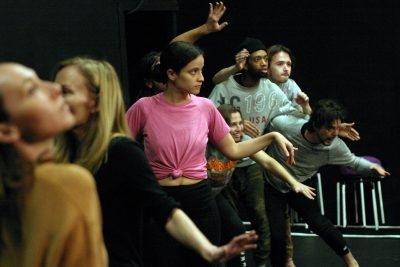
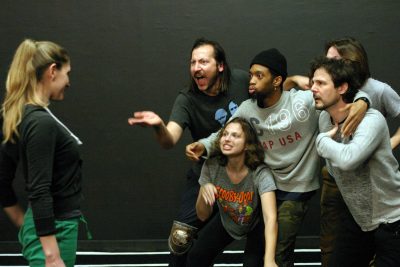
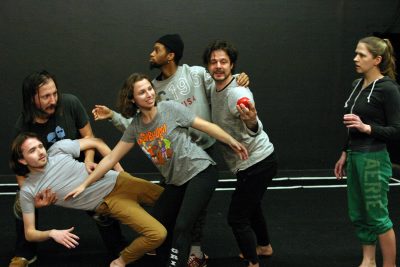
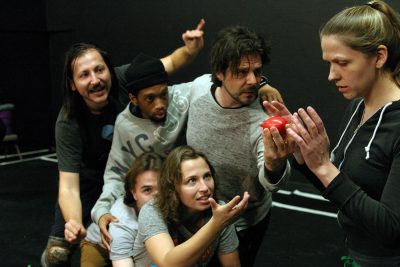
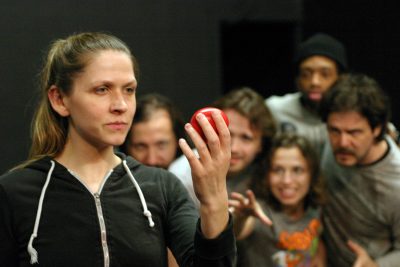
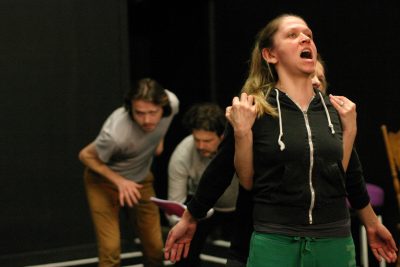
Although I had studied Sam Shepard in college, I didn’t remember learning about the sci-fi western, The Unseen Hand. I remember the intensity of his play, The Buried Child, and I recall his great love for the West, which seeped into the atmosphere of all his writing. In large part, however, I wasn’t sure what to expect when I took my seat in front of a battered convertible resting comfortably on the Odyssey’s stage. I did know I was excited for the ride. Before I could think too deeply about what I learned in World Theatre History, the lights came up to reveal Steve Howey in an electric chair, and I was suddenly struck by the recollection of what makes Shepard unique…he goes there. Many legendary playwrights use the act of playwriting to explore life, society, and perspective, but few can accomplish this while balancing shock and mystery all at once. Shepard’s work combines the two, offering its audiences equal parts drama and nuanced introspection. The Odyssey’s production of Killer’s Head/The Unseen Hand is a thrilling example of this dichotomy.
When I think of Westerns, I don’t typically think of metaphor or complexity. I attribute the genre to something akin to an action film, where the actual story is far less interesting than the excitement of combat. This is a generalization, of course, but a stereotype nonetheless. Shepard, on the other hand, uses the Western archetype as a backdrop to explore the motivation behind the excitement. The three brothers in The Unseen Hand enter the scene ready to fight, looking for any outlet to express their aggression, especially since the apparent lack of trains has forced them toward more creative pursuits. It’s a Western, but they’re in the future—train heists are therefore impossible. They release their aggression in various ways throughout the play, but there is an underlying question which pervades both the characters and the viewers: why? Why, upon returning from the dead, are they fixated on using their guns? Why are they obsessed with finishing the unfinished, even though they’re in the future now? Why do they jump to planning a revolt? These are the questions that make Shepard’s version of a Western distinct. Because it is not about the action at all, but rather why we crave it. The Unseen Hand with all its guns, southern slang, and glamorizing of the pioneer age, is really a play about the human psyche and our relationship to freedom.
Darrell Larson, the director, says The Unseen Hand is a play about toxic masculinity. In an even broader sense, I view it as a play about the roles we choose to perform on a daily basis. And it’s the roles we play that keep us from living a life that is truly free. I believe Sam Shepard understood this. When the actors emerged to take their final bows, I felt truly inspired to live more freely. What better way to honor Shepard and our lives than to experience the magic of his work through this fantastic production. To put it simply, this play is not your average Western.